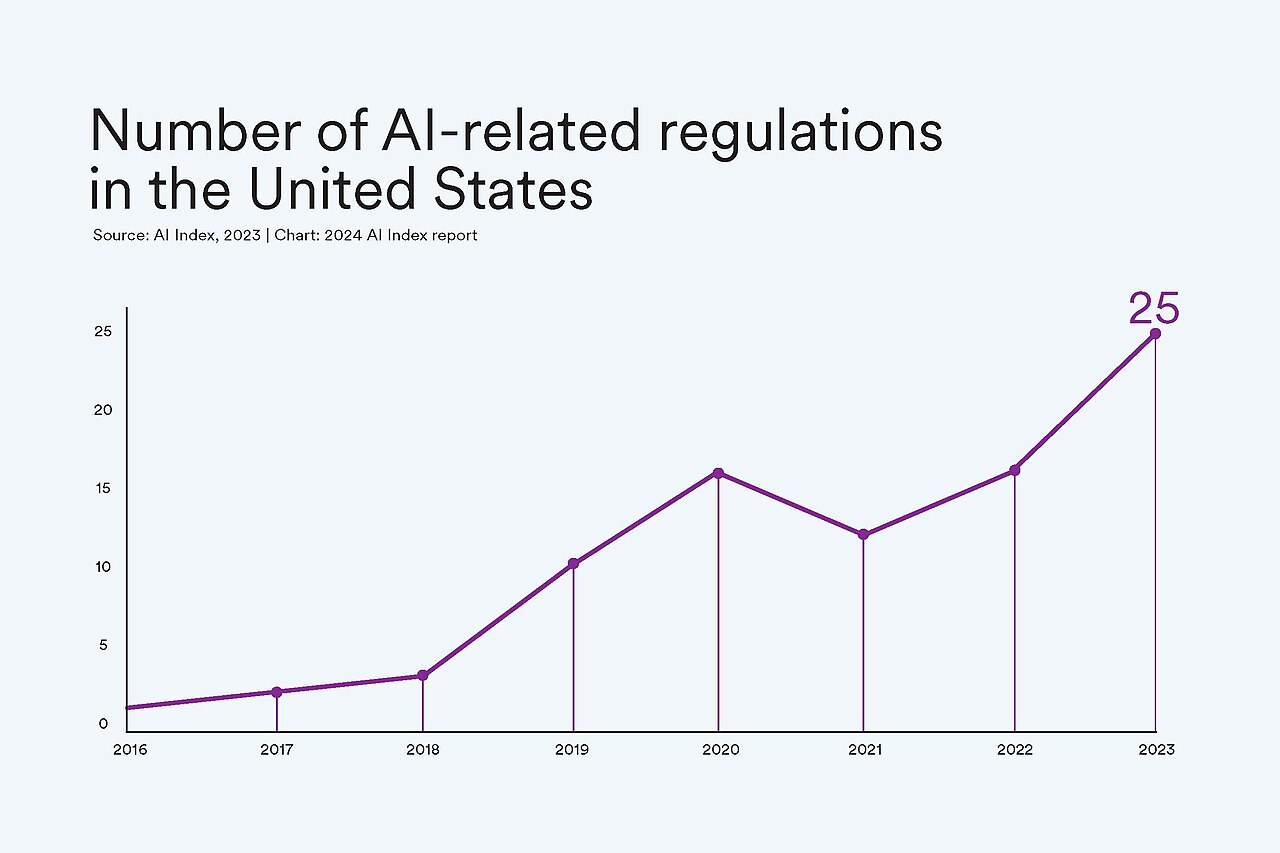
Artificial intelligence has moved from futurist talk to daily infrastructure, and that makes the current regulatory vacuum harder to defend. The case for doing nothing has always rested on speed: move fast, let the market sort it out, and intervene only after harms become undeniable. That argument is weaker now than it was a year ago, because the public debate has shifted from abstract possibility to concrete questions about labeling, testing, accountability, and who bears the cost when systems fail.
The strongest argument for restraint is familiar and not frivolous. A heavy-handed federal regime could freeze smaller firms out of the market, lock in the biggest incumbents, and push experimentation offshore. The technology is evolving quickly enough that rigid rules can become obsolete before they are implemented. Some industry leaders also warn that alarmist politics could smother benefits in medicine, education, logistics, and scientific research before those gains reach ordinary people.
But the opposing case is growing harder to ignore. Recent editorial debate in the United States has centered on whether lawmakers should create enforceable safety standards, independent evaluation of capable models, and clearer disclosure when people are interacting with AI systems rather than humans.1 That is not radicalism; it is the same logic society has long applied to aviation, pharmaceuticals, and other technologies where failure can scale quickly and invisibly.
The most persuasive version of the pro-regulation case does not demand a blanket slowdown. It asks for basic rules that make the market more trustworthy. Users should know when they are talking to a chatbot or encountering AI-generated material. Developers should be required to test the most powerful systems before deployment and to disclose enough about performance and safety to allow outside scrutiny. And if something goes wrong, there should be a clear chain of responsibility rather than a cloud of “move fast” excuses.1
That position is also gaining traction outside the op-ed pages. Reporting from the BBC says meaningful federal AI legislation remains unlikely in the near term, in part because Republican control of Congress and Donald Trump’s opposition make a broad new regime difficult to pass.2 NPR has likewise reported that lawmakers are under pressure to act, even if the path forward is uncertain.3 In other words, the political system is acknowledging the problem even as it struggles to solve it.
That is exactly why a narrower first step makes sense. A federal AI commission or comparable regulator would not need to dictate which models may exist or which companies may win. It could instead establish baseline duties: safety testing for high-risk systems, incident reporting, transparency obligations, and auditing standards that preserve room for competition while setting minimum public protections.1 If lawmakers fear overreach, they should begin with duties tied to measurable risk, not speculative fears.
Critics will say this is too little, too late, and they are not entirely wrong. The history of technology policy is littered with regulations written after the damage was done. There is also a legitimate concern that compliance costs will fall hardest on startups and researchers without the lobbying power of the largest platforms. A bad law could indeed strengthen the very firms it seeks to restrain.
Still, delay is not neutral. Each month without rules normalizes a business model in which systems that can influence speech, work, education, and security are released into the world with uneven disclosure and limited accountability. That is not an argument for panic. It is an argument for proportion. The goal should not be to ban progress or treat every new model as a threat. The goal should be to make sure the public is not asked to absorb the risks while private actors capture the rewards.
There is a broader civic point here. AI policy has become one of those debates where the two loudest sides are both partly right and partly self-serving. The industry is right that innovation matters and that bad law can do real harm. The skeptics are right that markets alone do not reliably manage systemic risk. The responsible middle is not indecision. It is regulation that is targeted, auditable, and flexible enough to adapt as the technology changes.
Our view is simple: Congress should stop treating AI as if it can be governed after the fact. A modest regulatory framework now would be an admission of maturity, not fear. The longer lawmakers wait, the more likely they are to write rules in response to a scandal rather than to foresight.
Sources: The New York Times; BBC News; NPR