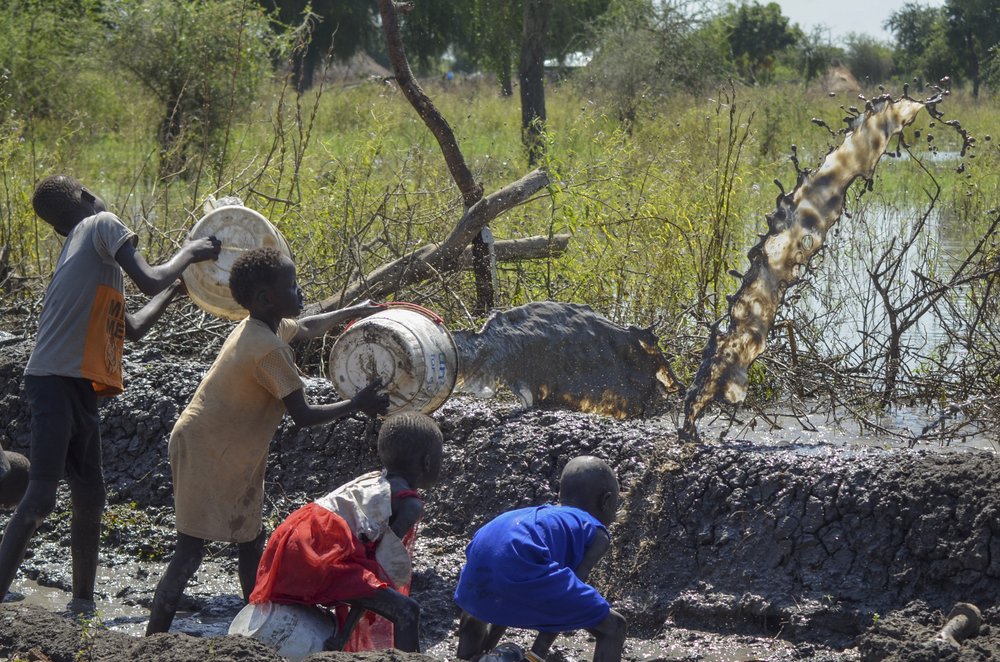
Commentary. At Archange Shadows, we believe the coming El Niño should be treated not as a temporary weather story but as a test of whether climate policy can protect people before disaster arrives. Forecasts that the 2026–2027 cycle could rank among the strongest on record, threatening the health, education and security of more than 347 million children, make delay a political choice rather than an administrative failure.
The warning comes as governments prepare for COP31 in Türkiye. Recent United Nations reporting describes record heat, destructive floods and rapidly worsening conditions in vulnerable communities. In Papua New Guinea, water sources are drying, crops are failing and food prices are rising before the worst agricultural effects are expected. These are not abstract projections. They are early indicators of how a climate shock becomes a food, health and education crisis.
Our position is straightforward: climate diplomacy remains necessary, but it is no longer sufficient. Governments should pair emissions cuts with immediate, funded adaptation—early-warning systems, climate-resilient schools and clinics, reliable water infrastructure, crop support and emergency financing that reaches local authorities. The measure of a summit should not be the elegance of its communique. It should be whether families are safer when the next flood, drought or heatwave arrives.
The case for urgency
The strongest argument for accelerated action is both moral and practical. Children contribute little to historical emissions yet face disproportionate risks to nutrition, schooling and physical safety. UNICEF’s projection of more than 347 million children exposed to serious disruption illustrates the scale of that imbalance. Waiting for perfect certainty would simply transfer costs to people with less power to absorb them.
There is also an economic case. Preventive investment can reduce the price of emergency relief, protect livelihoods and limit displacement. Water systems, resilient public buildings and better forecasting may lack the political drama of disaster response, but they preserve choices that crisis otherwise removes.
The counterargument deserves a hearing
Critics of rapid climate spending raise legitimate concerns. Governments facing war, inflation, debt and weak growth cannot fund every desirable project at once. Poorer countries may reasonably argue that wealthy states, whose past emissions helped create today’s risks, should provide more finance rather than impose new obligations. Businesses also warn that abrupt regulation can raise energy prices, weaken competitiveness and shift production to jurisdictions with lower standards.
Those objections should shape policy, not defeat it. Climate action that ignores household budgets will lose democratic support. The answer is a fair transition: targeted assistance for low-income consumers, predictable rules for industry, technology-sharing and grants—not loans alone—for countries already facing repeated disasters. Adaptation money should be transparent, locally directed and judged by outcomes.
What COP31 should demand
- Concrete adaptation commitments tied to measurable reductions in exposure and loss.
- Reliable financing for countries facing climate-related emergencies, with simplified access for local institutions.
- Protection for education, health and food systems in El Niño-prone regions.
- Faster emissions reductions that prevent adaptation from becoming an endless repair bill.
There is a temptation to treat an extreme El Niño as an unavoidable natural event and therefore outside political responsibility. That is misleading. Governments cannot control Pacific Ocean temperatures, but they can determine whether a drought becomes famine, whether a flood destroys a school and whether families receive warnings in time to move.
At Archange Shadows, we do not expect one summit to resolve the climate crisis. We do expect leaders to stop confusing promises with protection. The coming months offer a clear standard: spend earlier, protect fairly and cut emissions faster. Anything less is not caution. It is a decision to let the most exposed pay for everyone’s delay.
Sources
United Nations Security Council coverage; UN humanitarian briefing; UNICEF El Niño warning and climate coverage.