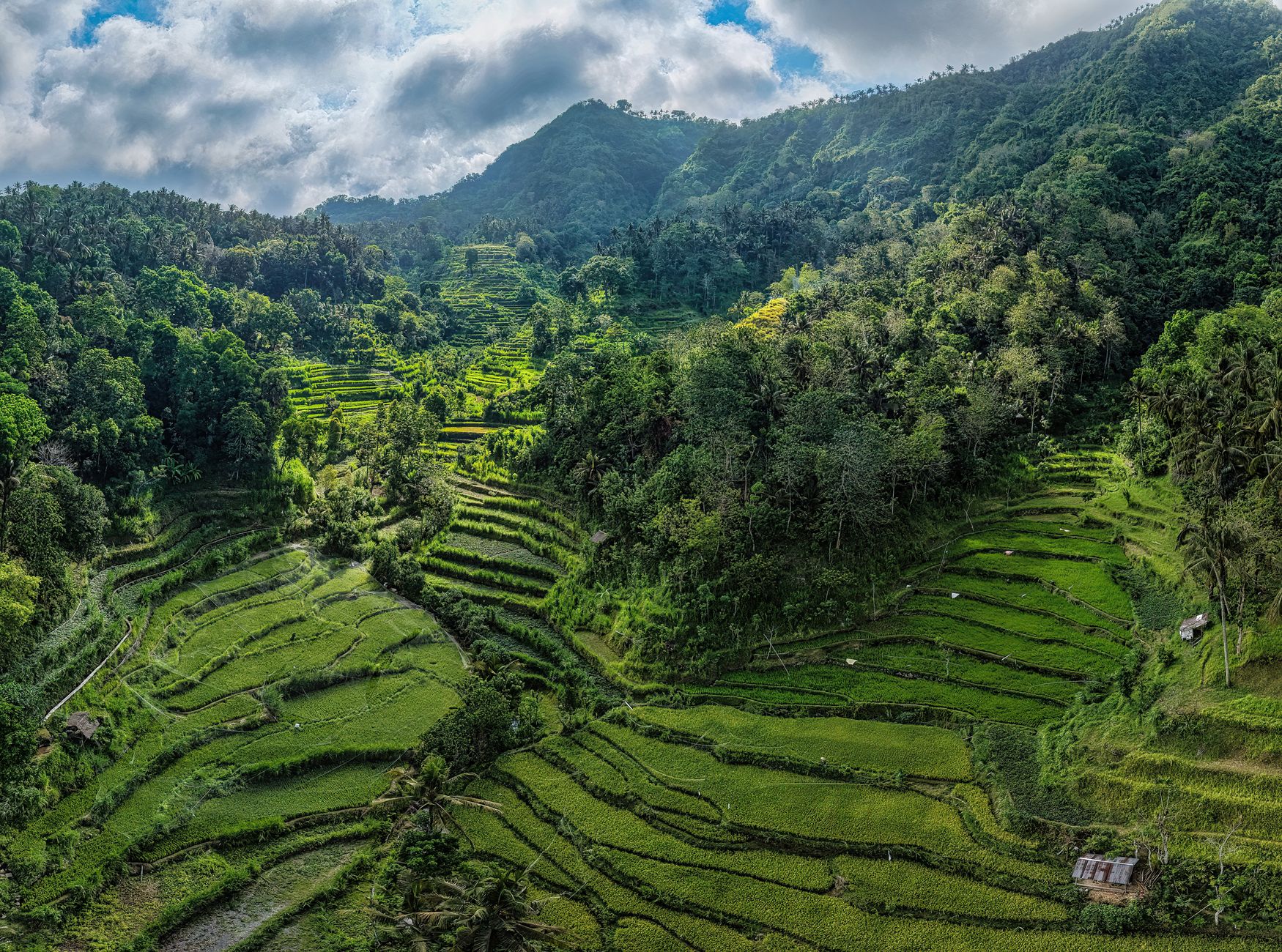
The Lush Heart of the Island
In the shadow of Bali's brooding volcanoes, where Gunung Agung pierces the sky like a divine spear, lies a landscape that seems woven from emeralds and mist. The rice terraces of Jatiluwih and Tegalalang cascade down hillsides in undulating waves, their perfect geometry a testament to human ingenuity harmonized with nature. This is the domain of subak, Bali's ancient irrigation cooperative—a social, spiritual, and agricultural system that has nourished the island for over a millennium. More than a method of farming, subak is a philosophy, a ritual, a covenant between the Balinese people, their Hindu gods, and the precarious gift of water.
At dawn, in villages like Kedisan or Sembangan, farmers—known as petani—gather not in boardrooms but at water temples. Clad in sarongs and selendangs, they offer incense, flowers, and prayers to Dewi Sri, the rice goddess, before channeling water through bamboo aqueducts and stone canals. These ceremonies are not optional flourishes; they are the system's soul. Subak governs every drop, allocating it equitably among hundreds of farmers via democratic councils called subak meetings, held under banyan trees sacred to the ancestors. Decisions are made by consensus, with the spirits invoked as silent arbiters.
This system, recognized by UNESCO as an Intangible Cultural Heritage in 2012, predates the great Khmer temples of Angkor by centuries. Born in the 9th century during the reign of ancient Balinese kings, subak emerged from the need to tame Bali's rivers and rains amid a triadic philosophy: harmony with the divine (parahyangan), with fellow humans (pawongan), and with nature (palemahan). It turned volcanic soil into a breadbasket, supporting a population density rivaling medieval Europe while fostering a worldview where excess is sin and balance is sanctity.
"Water is not ours to own; it is borrowed from the gods and our children," says Wayan Suardana, a subak leader in Tabanan regency, his voice steady as the canal beside him. "We farm not just rice, but righteousness."
Threads of Tradition in a Modern Tapestry
Bali's culture is a palimpsest, layered with influences from India, Java, and colonial Europe, yet subak endures as its most resilient thread. Unlike the fa'a Samoa of neighboring Polynesia, with its chiefly titles and 'ava ceremonies, or Papua New Guinea's thousand linguistic clans each with bespoke dances and yam hunts, subak is uniquely hydraulic. It is Oceania's engineering poem, where social structure mirrors the flow of water: decentralized, adaptive, inexorable.
Consider the ayahan rituals, performed at key planting stages. Farmers parade with offerings to the sea, returning with seawater to bless fields—a reminder of Bali's island essence. These acts bind communities in shared labor and liturgy, much as Luang Prabang's Buddhist alms-giving unites monks and laity in Laos. But subak's genius lies in its governance: each cooperative, numbering 15,000 to 20,000 across Bali, elects a pekaseh leader responsible for water distribution, fines for overuse, and temple upkeep. Disputes are settled not by lawyers but by oaths before the gods, with violators risking ostracism or divine retribution.
Women play pivotal roles too, managing temple offerings and weeding, their labor invisible yet indispensable. This egalitarianism within hierarchy echoes broader Asian patterns—from Vietnam's communal dong villages to Japan's mura cooperatives—but subak's spiritual core sets it apart. Every terrace ends in a shrine, every canal in a prayer. Rice, or padi, is no mere crop; it is prana, the breath of life, offered back in towering banten pyramids during Galungan festivals.
The Creeping Shadows: Tourism's Double Edge
Today, on this Sunday in April 2026, Bali hums with 7 million annual visitors, their selfies proliferating amid the terraces like digital weeds. Tourism, which accounts for 80% of the island's economy, has minted millionaires from rice farmers turned villa owners. Yet it exacts a toll on subak. Golf courses and luxury resorts guzzle water, diverting it from ancient canals. In dry seasons, exacerbated by El Niño, fields lie fallow, forcing farmers onto chemical monocrops like strawberries—profitable but profane in subak's organic ethos.
The numbers are stark. Bali's water table has dropped 20 meters in two decades, per government data. Subak memberships have halved since 2000, as youth flee to Denpasar or abroad, preferring air-conditioned jobs to mud-caked mornings. Concrete sprawl has paved over 30% of arable land. "Our water temples weep dry while foreigners sip infinity pools," laments Ni Luh Arini, a young subak priestess in Ubud, her eyes tracing a parched canal.
This crisis mirrors Asia's broader tensions: tradition versus globalization. In Hue, Vietnam, imperial tombs crumble under tourist feet; in Samoa, fa'a Samoa strains against remittances and migration. But Bali's stakes are existential. Subak is not just culture; it is ecology. Its terraces prevent erosion, filter pollutants, and sequester carbon—services valued at billions annually. Lose subak, and Bali risks becoming another Phuket: beachfronts sans soul.
Climate's Unforgiving Tide
Enter the great disruptor: climate change. erratic monsoons have shortened Bali's wet season by 10%, turning predictable abundance into roulette. Ha Long Bay's caves flood more fiercely; Balinese terraces thirst longer. Sea levels rise, salinizing coastal fields, while hotter days boost evaporation. Scientists project 50% rice yield drops by 2050 without adaptation.
Yet subak's adaptive DNA offers hope. Councils experiment with drip irrigation hybrids and drought-resistant heirloom strains, blending old rites with new tech. Drones map water flows; apps coordinate planting. The Balinese government, prodded by UNESCO, enforces 'green zones' barring development near temples. International aid, from the World Bank to Japanese NGOs, funds restorations—echoing Duke Kahanamoku's 1925 surfboard rescues off California, where Pacific Islander grit met modern peril.
"Subak taught us to share scarcity," explains Professor I Wayan Windia of Udayana University, a leading subak scholar. "In abundance, we forget; in drought, we remember."
Revival's Fragile Flames
Grassroots movements flicker amid the gloom. In Jatiluwih, a UNESCO site, youth cooperatives revive subak through eco-tourism: visitors join plantings, learn rituals, pay premiums for organic rice. 'Subak Rice' certification commands higher prices, subsidizing temples. Artists like Le Mayhew paint terrace murals; musicians compose gamelan suites saluting Dewi Sri. Social media, once a foe, now amplifies: #SaveSubak trends among influencers, drawing global donors.
Politics intervenes too. Governor Wayan Koster's 2024 'Water for Life' decree mandates subak curricula in schools, training 10,000 students yearly. Village laws cap villa permits, fining violators with communal labor. Yet challenges persist: corruption siphons funds; urban migration hollows villages. Women, bearing dual burdens of farm and family, push for quotas in councils—a quiet feminist revolution.
Comparative lenses sharpen the analysis. Polynesia's voyaging canoes, revived post-colonially, parallel subak's resilience. Papua New Guinea's clans adapt hunting to logging booms; Bali's farmers to Bali Ha'i hordes. Across Oceania and Asia, from Fiji's Indo-Fijian fusions to Japan's post-Fukushima communalism, indigenous systems prove antifragile—stronger through stress.
The Gods' Verdict
As twilight drapes the terraces, a subak meeting convenes in Tabanan. Under the banyan, elders and novices debate rationing amid forecasts of La Niña rains. Incense curls skyward; consensus emerges. No votes, no victors—only harmony restored. This, argues cultural historian Adrian Vickers, is subak's true export: a model for our warming world, where water wars loom from the Mekong to the Murray-Darling.
Bali stands at a precipice. Will subak fade into folklore, like Hawaii's lost monarchy, or evolve into tomorrow's template? The petani, faces etched by sun and supplication, hold the answer. In their hands, water flows not as commodity but communion. As one farmer puts it, "If we fail the gods, the gods fail us not—they simply turn away."
The terraces shimmer on, a verdant mandala defying entropy. For now.