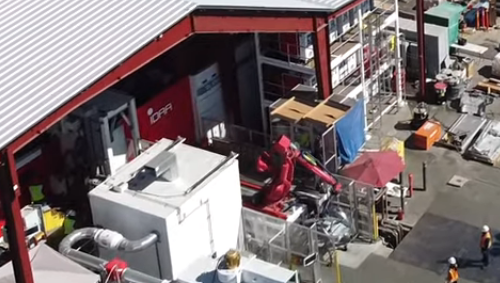
The artificial-intelligence boom is increasingly being measured not only in model releases and software valuations, but in machines moving through factories. Global industrial-robot installations rose 11 percent to more than 600,000 units, while the operating stock exceeded 5 million last year, according to the International Federation of Robotics.[1] The figures point to a broader transformation: AI is becoming part of the physical economy, where competitiveness depends on electricity, chips, skilled workers and the ability to automate production at scale.
China sits at the center of that shift. Its annual robot installations increased 20 percent to roughly 354,000, accounting for 59 percent of global deployment. Chinese manufacturers also captured 55 percent of their domestic market, an indication that the country is moving beyond importing automation toward building its own industrial systems.[1] Japan, long associated with robotics leadership, recorded a 19 percent decline in installations to 36,219, while the United States rose to second place with 38,500 installations.[1]
Why the numbers matter
Robot adoption is not simply a story about replacing workers. Companies are using automated systems to address labor shortages, improve consistency and shorten production cycles. AI-enhanced machines can inspect products, move components and adjust processes with less human intervention. For manufacturers facing volatile supply chains and rising costs, that flexibility can be as valuable as lower wages.
The economic stakes are large. The World Economic Forum’s latest survey found that 56 percent of chief economists expected global conditions to remain unchanged or improve over the following year, while India and Southeast Asia were identified as especially strong growth prospects.[2] That relatively cautious optimism creates incentives for firms to invest selectively in productivity-enhancing technology rather than build capacity solely through hiring.
Yet automation can widen the gap between companies and countries. Large firms can absorb the cost of robots, data systems and specialized engineers; smaller manufacturers may struggle to finance the transition. The result could be a more concentrated industrial economy in which the most productive companies gain market share while less automated competitors retreat.
China’s advantage—and its limits
China’s lead reflects more than factory demand. It combines a huge manufacturing base, government support, dense supplier networks and an expanding domestic robotics industry. Local production can reduce costs and limit exposure to foreign controls, while large-scale deployment gives Chinese firms experience that may improve products and services.
That advantage also creates strategic anxiety in Washington and European capitals. Industrial robots are civilian equipment, but the same capabilities—precision manufacturing, computer vision and autonomous control—can support aerospace, logistics and defense production. As trade restrictions increasingly target advanced chips and critical technologies, automation is becoming part of the wider contest over resilient supply chains.
China’s lead is not decisive in every layer of the technology. High-end semiconductor equipment, advanced processors and some software capabilities remain concentrated among companies in the United States, Europe, Japan and elsewhere. Nor does installing more robots automatically produce higher productivity: factories need reliable power, interoperable software, maintenance expertise and workers able to redesign production around automation.
The labor question
Supporters argue that robots can make unpleasant or dangerous work safer and help aging societies maintain output. They also point to new jobs in engineering, maintenance, data management and system integration. On this view, the central policy challenge is not stopping automation but ensuring workers can move into the occupations it creates.
Critics counter that the transition costs are immediate and uneven. Workers displaced from routine manufacturing may not qualify for technical roles without substantial retraining, and new jobs may emerge in different regions or offer lower bargaining power. The distribution of gains will therefore depend on education, labor protections, competition policy and whether productivity improvements translate into higher wages.
What comes next
The next phase will likely be less about spectacular demonstrations and more about integration. Companies will combine robots with computer vision, generative-AI systems and digital twins to coordinate entire production lines. Demand will also spread beyond automotive factories into warehouses, electronics, food processing and healthcare.
Governments face a difficult balance. Subsidies can accelerate domestic capacity, but fragmented national strategies may raise costs and encourage duplication. A more durable approach would support research, technical education, power-grid investment and common safety standards while preserving competition between suppliers.
The figures do not prove that China has won the industrial technology race, nor that automation will produce broad prosperity. They do show that the contest has moved from laboratories into factories. The countries that combine advanced software with affordable energy, capable workers and dependable supply chains will determine whether AI becomes primarily a productivity dividend—or another source of economic concentration and geopolitical rivalry.