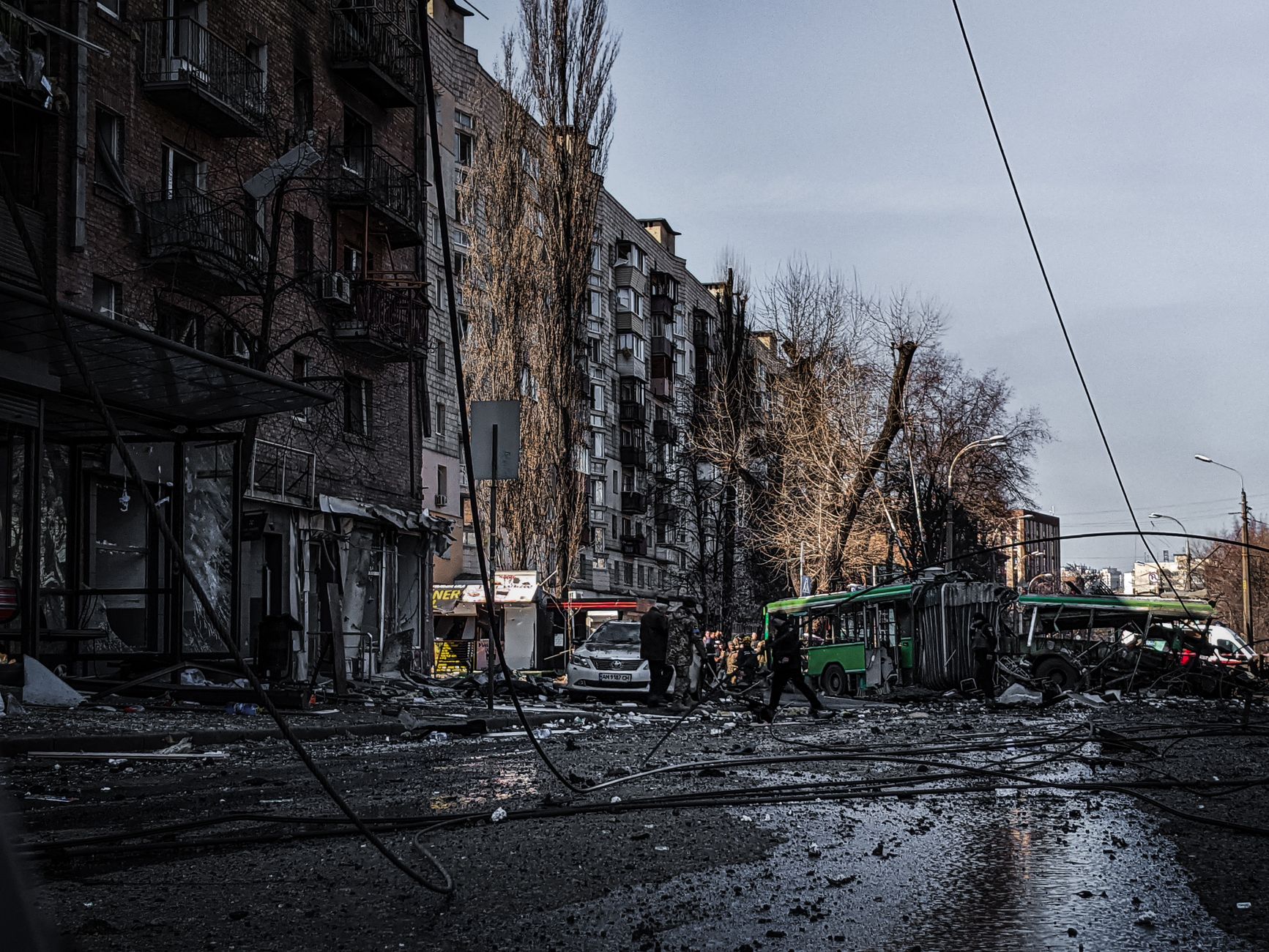
A war fought against the lights
Ukraine entered the latest phase of its war with Russia facing two realities at once: an intensifying campaign against its infrastructure and the possibility of renewed diplomacy. On November 7 and 8, Russian attacks struck Kyiv and energy facilities across the country, injuring nine people and damaging a substation linking the Rivne and Khmelnytskyi nuclear plants with Kyiv and central Ukraine. Authorities reported extensive outages in seven regions.[8]
The scale of the assault was substantial. Ukraine’s Air Force said Russia launched 227 attack drones, including 86 jet-powered aircraft. Ukrainian defences reportedly destroyed or suppressed 196 of them, although impacts were recorded at 14 locations and debris fell at eight others. These figures describe not only a military exchange, but an effort to make civilian life increasingly precarious.[1][3]
In eastern Ukraine, the consequences were immediate. More than 600,000 people in the Dnipropetrovsk region lost electricity after overnight strikes damaged important energy facilities, according to the power company DTEK. In the Kharkiv region, another attack reportedly left nearly 250,000 customers without power.[8]
This is the logic of the winter campaign: damage the grid, exhaust emergency services and force families to choose between warmth, safety and movement. The objective is not simply to destroy equipment. It is to turn infrastructure into leverage.
The civilian cost
The human cost is even harder to absorb. The death toll from a Russian attack on a former school and shelter in Komyshuvakha, in southeastern Ukraine, rose to 53. The site was being used to distribute humanitarian aid, and the strike reportedly involved 10 guided bombs.[5][6]
The attack illustrates the vulnerability of places that should stand outside the battlefield: shelters, aid points, schools and energy installations. When such sites are hit, the damage extends beyond the immediate victims. It weakens public confidence in evacuation routes, humanitarian work and the possibility of refuge.
For Ukraine, each destroyed facility adds to a national burden already measured in disrupted services, displacement and bereavement. For the international community, the pattern presents a test of whether condemnation can be translated into protection, accountability and material support.
Talks amid escalation
Against this backdrop, Ukraine, Russia and the United States are preparing for trilateral talks in Abu Dhabi on November 10 and 11. The meeting would be the first three-way discussion since February and is expected to address the war’s end, post-war security arrangements, de-escalation and humanitarian measures.[1][3]
Russia is sending a delegation that includes presidential aide Vladimir Medinsky, Deputy Foreign Ministers Sergei Ryabkov and Mikhail Galuzin, intelligence chief Igor Kostyukov and senior General Staff officer Yury Zhigarlovsky.[1][4] The composition suggests that Moscow intends to combine diplomatic messaging with security and military expertise.
Talks are valuable precisely because the alternative is continued destruction. Yet negotiations cannot be judged by their symbolism alone. Any credible process must address civilian protection, the restoration of energy infrastructure, prisoner exchanges, humanitarian access and the security guarantees required to prevent a temporary pause becoming preparation for another offensive.
The timing is also troubling. Russia’s delegation was announced as Ukraine endured another large aerial barrage. That juxtaposition raises a central question: are the strikes intended to strengthen Moscow’s negotiating position, or do they demonstrate that the Kremlin has little interest in compromise? Either way, the attacks will shape the atmosphere in Abu Dhabi.
The widening battlefield
The war’s reach was also visible inside Russia. A major fire broke out at an electronics factory in Oryol after an overnight strike reportedly involving a Ukrainian Neptune coastal missile. The facility had previously been hit on October 23.[4]
Ukraine’s attacks on Russian territory underline the conflict’s expanding geography and Kyiv’s effort to impose costs beyond the front line. But escalation carries risks. Each strike can damage military production while also increasing the danger of wider retaliation against Ukrainian cities and infrastructure.
The challenge for negotiators is therefore immense: to reduce violence without rewarding coercion, and to pursue an agreement that does not merely postpone the next phase of war.
A narrow opening
The Abu Dhabi talks should neither be dismissed nor romanticised. Diplomacy cannot erase the devastation of the past days, and no meeting can by itself restore power to hundreds of thousands of people or bring back those killed at a humanitarian facility.
Still, dialogue remains necessary. Ukraine needs practical protection and a sustainable peace, not a pause that leaves its population exposed. Russia must face pressure to stop attacks on civilians and critical infrastructure. The United States and its partners must ensure that negotiations are backed by clear consequences, credible guarantees and long-term support.
The coming winter may determine whether diplomacy becomes a path towards restraint or another stage in the war’s contest of endurance. For Ukraine, the measure of any peace process will be simple: whether it makes people safer, keeps the lights on and prevents the next tragedy.