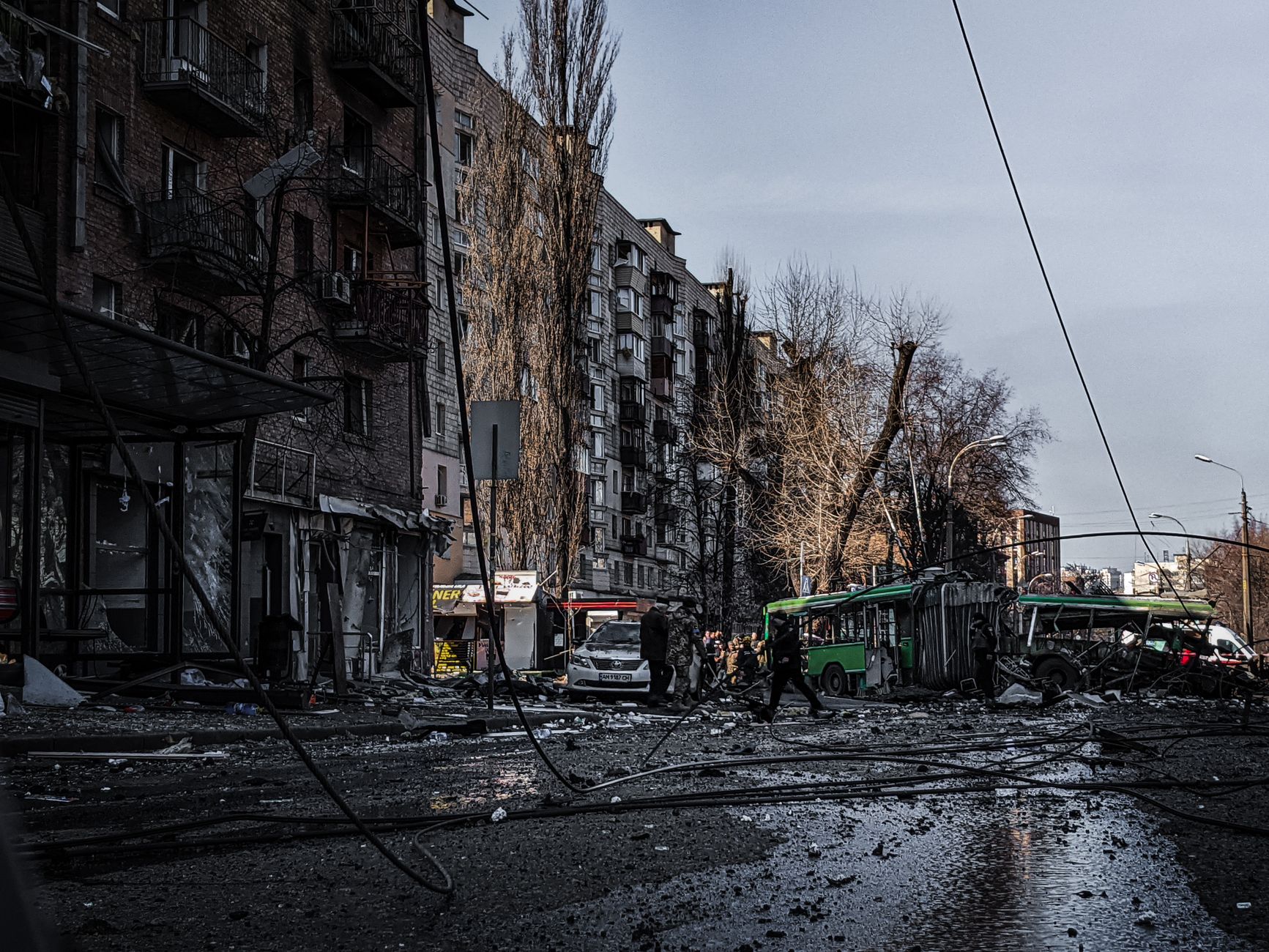
Air raids as strategy, not just terror
Russian missile and drone attacks over the past days have turned much of Ukraine into a testing ground for industrial‑scale aerial warfare, with civilians once again paying the highest price.[2][11] Recent strike series have been extraordinary not only for their brutality, but for their sheer volume: barrages involving hundreds of drones and dozens of missiles launched in single operational windows against Kyiv, Dnipro, Poltava, Kharkiv, and Zaporizhzhia.[2][11]
An eleven‑hour attack on Kyiv killed 31 civilians and injured more than 100, a death toll more typical of a battlefield engagement than a capital city at night.[11][14] Another assault, among the largest of the war, saw 656 drones and 73 missiles fired at multiple cities, leaving at least 18 dead and over 100 wounded.[11] A further strike package reportedly included around 600 drones and 90 missiles, one of them a nuclear‑capable “Oreshnik” hypersonic ballistic missile hitting Bila Tserkva near Kyiv, killing at least 4 and injuring more than 60.[2]
In just about a 24‑hour period, Ukrainian officials have counted more than 1,560 drones and 56 missiles launched across the country, killing at least 11 people and prompting Slovakia to close a land border crossing as strikes reached Ukraine’s western frontier.[2] These are not isolated incidents; they form part of a sustained very high‑volume aerial campaign designed to exhaust Ukraine’s air defenses, terrorize its population, and demonstrate that Russia still has escalation tools at its disposal.[1][2][11]
There is a strategic logic at work. Russian officials themselves have framed at least some of these operations as retaliation for Ukrainian long‑range strikes on Russian oil facilities, suggesting that energy infrastructure and urban populations on both sides are now squarely integrated into the war’s coercive calculus.[11] Whatever Moscow’s claimed targets, the result on the ground is visible in burnt apartment blocks, shattered transport hubs, and emergency services racing between impact sites.
Positional warfare and the geometry of stalemate
Yet for all this violence, the front lines barely move. On 17 July, there were no confirmed territorial advances by either Russian or Ukrainian forces, a snapshot that reflects a broader 2026 pattern of attritional, positional fighting.[1] Russia’s gains over the preceding six months have been limited and costly: roughly 40.64 km² taken or infiltrated between December 2025 and May 2026, while Ukraine reclaimed about 281 km² in the same period.[10]
Against this backdrop, Russian Defense Minister Andrei Belousov’s recent high‑level meeting with his deputies and General Yun‑Bek Yevkurov is telling.[1] Instead of announcing new mechanized offensives or grand encirclement plans, the Defense Ministry is reportedly prioritizing refining capabilities for sustained positional combat.[1] In plain terms, Moscow appears to be preparing for a long war of endurance rather than a decisive campaign of maneuver.
This choice has consequences. Positional warfare favors firepower, logistics, and industrial capacity over dramatic operational breakthroughs. It turns towns and trenches into fixed points in an equation measured in shells, drones, and bodies. For Ukraine, it means daily exposure to attacks without the compensatory morale boost of visible liberation on the map. For Russia, it means continuous expenditure of matériel and manpower for marginal territorial gain.
The aerial onslaught of the last 48 hours sits squarely within this logic: where ground offensives stall, missiles and drones become the primary instrument for maintaining pressure and signaling resolve.
Kyiv reshuffles its war cabinet
Amid this grinding battlefield stalemate, Ukraine’s political leadership is in motion. On 16 July, President Volodymyr Zelensky engineered a significant reshuffle in Kyiv that goes to the heart of how the war is managed.[5]
Parliament approved Serhiy Koretsky, formerly the CEO of the state‑run energy firm Naftogaz, as prime minister, replacing Yulia Svyrydenko.[5] Zelensky also designated Yevheny Khmara, acting head of the Security Service of Ukraine, as interim defense minister to replace outgoing defense chief Mykhailo Fedorov, though Khmara’s appointment still awaits parliamentary consideration.[5] These moves unfolded amid domestic protests linked to Fedorov’s dismissal, a reminder that even in wartime, public scrutiny of the government’s management of mobilization, corruption, and military risk remains intense.[5]
Bringing an energy executive into the prime minister’s role is more than a personnel detail. In a conflict increasingly defined by strikes on pipelines, refineries, and power grids, energy management is national security. Koretsky’s experience at Naftogaz could align Ukraine’s economic policy with the realities of wartime infrastructure defense and reconstruction.
Similarly, placing a security service chief at the helm of the defense ministry—at least in an interim capacity—suggests a desire to integrate intelligence, counterintelligence, and military planning more closely.[5] The shake‑up signals that Zelensky is recalibrating the inner circle that will handle the next phase of a war that is simultaneously stalemated on the ground and escalating in the air.
Ukraine’s asymmetric answer: drones over Crimea and the Black Sea
Ukraine is not merely absorbing blows. It has intensified long‑range drone operations against Russian logistics and fuel transport networks, especially those supplying forces in occupied Crimea.[5][3] These strikes are assessed to be straining Russia’s air defenses, already stretched thin by the need to protect refineries, export terminals, and front‑line units.[5][3]
In June and July, Ukrainian units struck oil‑tanker vessels near Primorsk and Ust‑Luga and conducted large drone attacks against Russia’s Black Sea region, continuing a campaign that aims to make the occupation of Crimea and the maintenance of Russia’s war machine materially more expensive.[3][10] Recent reports of multiple Russian vessels hit in the Black and Azov Seas reinforce that Ukraine’s maritime and long‑range strike capabilities are becoming central to its strategy.[7][10]
This asymmetric approach—disrupting logistics rather than trying to match Russia missile for missile—carries risks, including escalation and retaliatory strikes like those now hitting Kyiv and other cities.[2][11] But it also offers Kyiv a way to impose costs behind enemy lines, at a time when large‑scale ground offensives are constrained by manpower and ammunition.
Pressure inside Russia
The war’s strain is not confined to Ukraine’s cities or trenches. Russia’s focus on sustaining its campaign, combined with ineffective economic policies, is contributing to a broader economic downturn at home.[1] A state‑affiliated polling center has reported a significant decline in President Vladimir Putin’s approval rating, a notable datapoint in a political system that relies heavily on the projection of stability and popular backing.[1]
Moscow is reportedly turning to India for gasoline imports as domestic refining capacity suffers from Ukrainian strikes and structural weaknesses.[5][3] Fuel shortages and inflation feed into public frustration; frustration, in turn, erodes the narrative of a cost‑free “special military operation.”
For now, Russia’s leadership appears committed to its positional strategy, trading economic pain and international isolation for incremental gains and the hope that Western support for Ukraine will eventually wane. Ukraine, meanwhile, is reorganizing its wartime leadership and doubling down on long‑range strikes to offset its disadvantages in manpower and missiles.
Between hypersonic projectiles over Bila Tserkva and reshuffles in Kyiv’s ministries, the last 48 hours have laid bare the war’s current phase: a contest of endurance, where the front lines rarely move, but the political and economic ground beneath both capitals is anything but stable.[1][2][5][10]