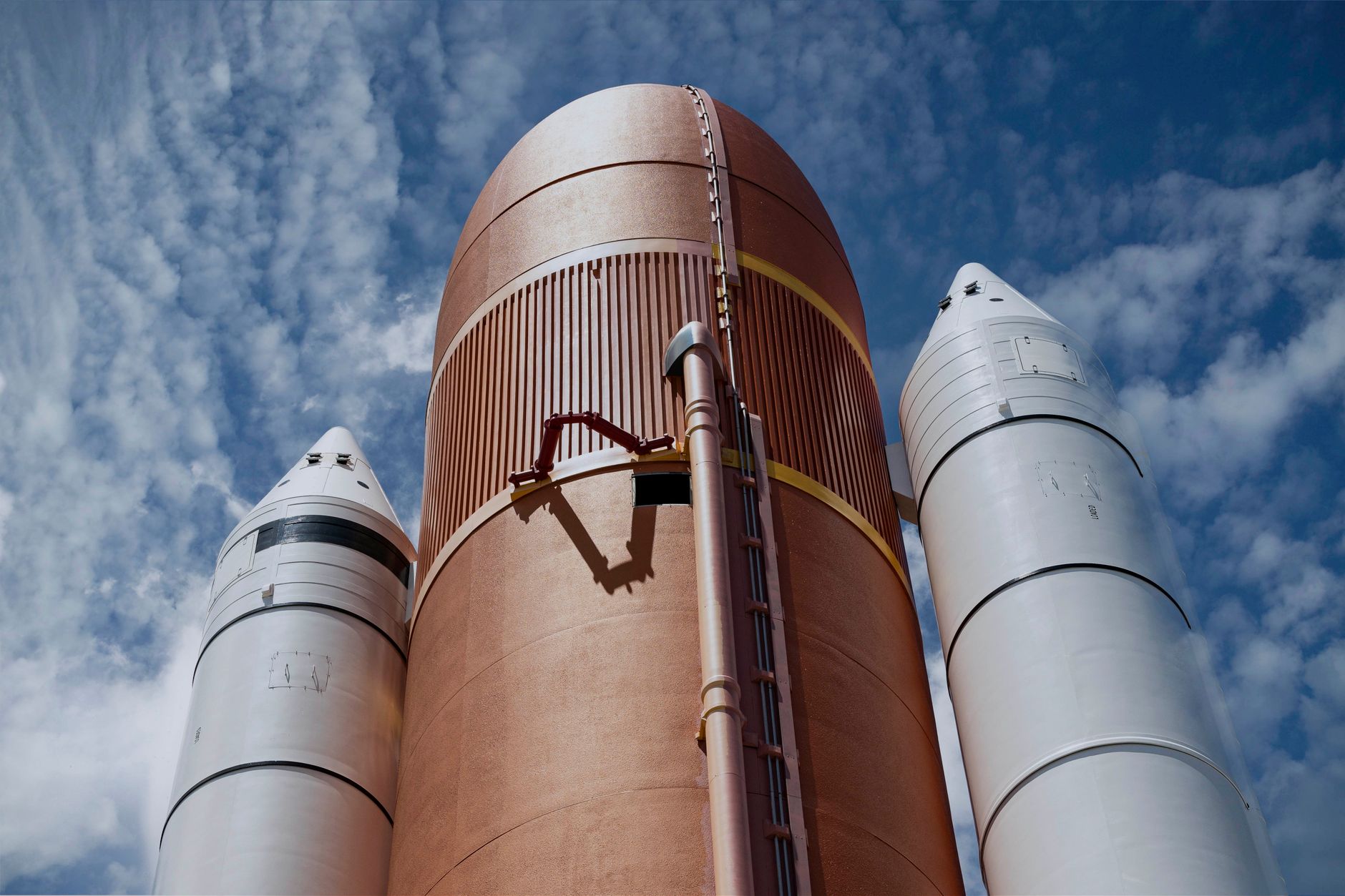
The frontier has changed shape
For most of the space age, a successful launch meant one thing: getting there. Getting into orbit. Getting to the Moon. Getting a probe past the edge of the known. The drama was in the act of arrival, and the politics lay in who arrived first. That era is not over, but it is no longer the main story. The more consequential development in space exploration today is that launch has become routine enough to support a new kind of ambition: not spectacle, but system-building.
The clearest example is the increasingly tight partnership between NASA and SpaceX, which has turned access to orbit into a higher-frequency service rather than an occasional national event. Recent NASA missions aboard a SpaceX Falcon 9, including SPHEREx and PUNCH, reflect a broader change in how science is done in space: smaller payloads, faster iteration, and missions designed to produce large scientific returns from relatively modest hardware. SPHEREx is intended to create a three-dimensional all-sky map of hundreds of millions of galaxies, while PUNCH will study how the Sun’s outer atmosphere drives space weather that affects satellites, communications, and power grids. That is not conquest in the old sense; it is infrastructure for knowledge.[1]
The significance of this shift is easy to miss because launch days still resemble launch days: countdowns, flames, applause, and technical jargon. But behind the theater is a more profound transformation. Space is being reclassified from a realm of rare achievements into a working environment for science, commerce, and strategic capability. The question is no longer simply whether humanity can reach space. It is whether it can make space useful at scale.
SpaceX has made repetition its revolutionary act
SpaceX’s influence on this transition is difficult to overstate. The company’s original disruption was not merely that it flew rockets; it made rockets reusable, which gradually changed the economics and tempo of access to orbit. The result is a launch market in which cadence itself has become a measure of power. In 2025, SpaceX broke its own annual launch record, and Falcon 9 remained the workhorse of American access to space.[3] Even as Starship continues to mature through test flights, Falcon 9 has become the dependable backbone of both commercial and government missions.
That matters because science does not advance on symbolism alone. It advances when instruments can fly often, when failures are tolerable, and when a mission no longer has to be designed around the premise that it may never fly again. A reusable launch system makes scientific programs more modular. It also changes the politics of risk. A government agency such as NASA can now buy access to orbit in a way that resembles purchasing reliable transport rather than commissioning a national monument.
The consequences are visible in the kind of missions being launched. SPHEREx is not a deep-space stunt; it is a broad survey instrument built to answer fundamental questions about cosmic inflation, galaxy formation, and the distribution of water and organic molecules in the universe. PUNCH is similarly pragmatic and profound, watching the Sun not as a distant object of wonder but as a source of hazardous weather. Together they embody a new philosophy of exploration: measure more, map more, predict more.
“The big breakthroughs now are often not the most theatrical ones. They are the missions that make the universe legible.”
NASA’s new role is to multiply intelligence, not just presence
NASA is adapting to a reality in which the agency no longer needs to build every launch system itself to remain central to exploration. That is a substantial institutional change. For decades, NASA’s prestige was bound up with its hardware: Saturn V, the Space Shuttle, the space station. Today, its relevance increasingly comes from the scientific architecture it designs and funds, even when a private company carries the load to orbit.[2]
This does not mean the agency has become less important. It means its comparative advantage has shifted. NASA’s science missions are the clearest proof. By pairing its scientific agenda with commercial launch capacity, the agency can pursue more missions, at lower marginal cost, than a government-only model would likely allow. In practical terms, that means more telescopes, more observatories, more atmospheric studies, more planetary probes, and more room for failure and learning.
There is also a strategic dimension. Space is no longer a discrete theater separated from Earthly life. It is entangled with communications, navigation, weather forecasting, climate monitoring, and national security. Missions like PUNCH are relevant because the Sun’s activity can disrupt satellites and radio systems that modern economies depend on. The same orbit that carries a telescope can also host the sensors that help us understand and defend the systems on which terrestrial life now relies.
NASA’s value, then, lies not simply in going places, but in turning those places into knowledge networks. That is a subtler achievement than planting a flag, and perhaps a larger one.
The science of the 2020s is increasingly interdisciplinary
The most striking feature of current breakthrough science is how rarely it stays confined to one discipline. Space exploration is now linked to physics, climate research, medicine, computing, and materials science. The same institutional ecosystem that launches a telescope can also support a medical investigation or a new physics experiment. The frontier is becoming less like a line and more like a mesh.
Recent scientific reporting has highlighted advances that would once have seemed unrelated but now belong to the same story. In physics, researchers have pushed forward on tools and methods designed to handle vast data streams from particle experiments, including artificial intelligence systems built to process collider-scale information.[4] In medicine, studies continue to clarify risks associated with environmental exposures and metabolic change, while other work explores how broadening the use of established therapies may improve outcomes for patients with chronic disease.[4] In climate and ecology, research has shown how deforestation and ecosystem disruption can alter disease transmission patterns by changing the behavior of mosquitoes and other vectors.[4]
Why include these developments in a story about space? Because they point to the same underlying reality: modern science is increasingly about systems. A telescope surveys galaxies, but its data architecture resembles that of a climate model or a particle detector. A mission to study the Sun is also a mission to protect the digital infrastructure of Earth. A medical breakthrough depends on the same capacities for instrumentation, computation, and pattern recognition that now drive astrophysics.
The old division between “big science” and practical science is eroding. What counts now is whether a field can generate usable intelligence from complexity. Space agencies, climate researchers, and medical scientists are all asking versions of the same question: how do we extract signal from scale?
The climate connection is no longer optional
Space exploration was once sold as an escape route from Earth. That framing now looks dated, almost evasive. The most important new space missions are not about leaving the planet behind; they are about understanding the planet more accurately. Climate research depends heavily on orbital observation, and the same launch systems that send telescopes into deep space also place Earth-monitoring instruments where they can measure atmospheric change, ice loss, cloud dynamics, and ocean behavior.
That connection matters because the climate crisis has changed the moral grammar of exploration. A mission is no longer impressive merely because it is difficult. It is impressive if it helps answer urgent questions about how Earth is changing and how human systems can adapt. Space assets are increasingly indispensable to that effort. They provide continuous observations that would be impossible from the ground alone, and they turn the planet itself into a measurable object of policy.
In this sense, the latest launch stories are not a retreat from Earth-bound problems but an extension of them. The same industrial capacity that can support lunar ambitions can also support weather prediction, wildfire monitoring, agricultural planning, and disaster response. The most credible case for space investment today is therefore not romantic. It is civilizational. A richer orbital presence improves the management of a fragile planet.
The medical frontier is moving in parallel
Medical discovery often appears distant from the rocket business, but the relationship is closer than it seems. Space medicine has long been a useful laboratory for studying bone density, muscle loss, fluid shifts, and immune response in extreme environments. Yet the more important connection may be methodological. Space programs reward miniaturization, automation, and remote sensing, all of which are equally valuable in healthcare.
Recent research summaries have pointed to studies on metabolic disease, medication benefits, and environmental health risks that reflect the wider trend toward data-rich, mechanism-driven medicine.[4] These are not moonshot cures in the cinematic sense. They are incremental but meaningful refinements in how disease is understood and treated. That is the real pattern of modern biomedical progress: fewer miracles, more precision.
There is also a cultural parallel. Just as space science has moved from a few national heroes to a dispersed network of launch providers, satellites, and instruments, medicine is becoming more distributed in its methods. It relies on platforms, datasets, and predictive tools rather than singular breakthroughs alone. The frontier is becoming less about dramatic intervention and more about sustained measurement.
That may sound less inspiring than the language of exploration, but it is more durable. It is also more honest about how progress happens.
The new competition is not for prestige, but for capability
For much of the 20th century, the contest in space was geopolitical and symbolic. The United States and the Soviet Union competed to demonstrate supremacy, and the result was a series of dramatic firsts that still define the public imagination. Today’s competition is more diffuse. The relevant question is not who can stage the grandest one-time achievement, but who can sustain launch capacity, scientific output, and technical resilience over time.[5]
That is why SpaceX matters so much, and why NASA’s choices matter just as much. A launch provider that can fly repeatedly alters the behavior of the entire ecosystem. It lowers barriers for universities, agencies, and companies. It shortens the cycle between proposal and result. It also creates a new dependence: the scientific establishment now leans on private industrial capacity that would have seemed extraordinary, even risky, a generation ago.
There are legitimate concerns in that arrangement. Concentrated launch capability can become concentrated leverage. Commercial imperatives may not always align neatly with public science. And a launch system optimized for frequency may not always be the best answer for every mission class. But these risks are not a reason to romanticize the old model. They are the price of entering an era in which access to orbit is becoming as strategically important as access to bandwidth or cloud computing.
The broader lesson is that space has become a substrate. It is where scientific instruments are placed, where communications are routed, where climate is monitored, and where the limits of American industrial power are tested. In that sense, the new space age is less about exploration as event and more about exploration as capacity.
The real breakthrough is an ecosystem
The most important scientific story in space today may therefore be that multiple revolutions are converging. Reusable rockets have made access to orbit more routine. NASA has adapted by emphasizing missions that maximize scientific yield. New instruments are mapping the cosmos and the Sun with unprecedented precision. Climate and medical research are increasingly dependent on the same data-rich infrastructure. Physics, too, is being reshaped by computational tools capable of handling impossible quantities of information.[1][4]
Seen separately, these are promising developments. Seen together, they describe an ecosystem coming into maturity. Space is no longer a realm where only rare heroic acts matter. It is becoming a field defined by throughput, analysis, and integration. That makes it less glamorous in some respects, but far more consequential.
The old question was whether humanity could go to space. The new one is whether it can use space wisely. The answer, for the moment, is beginning to look like yes.